
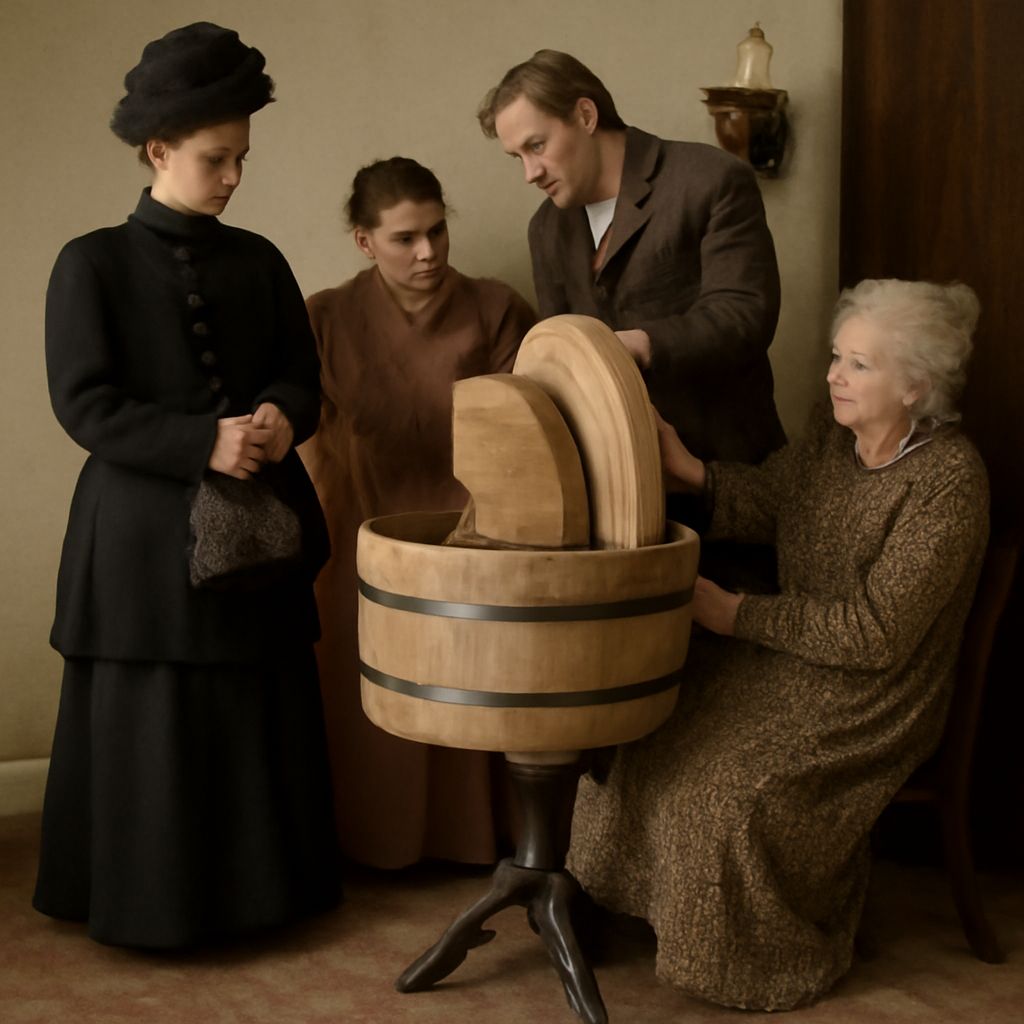
The most accurate answer to who invented the washing machine depends on which milestone counts as the invention. Jacob Christian Schäffer published the earliest widely documented design in 1767, while later inventors patented rotary drums, added wringers, introduced electric power, and developed automatic cycles.
So, when was the washing machine invented? The answer begins in 1767, but the household appliance developed over more than 170 years. No single inventor created every mechanism now associated with a modern washer.
Who Invented the Washing Machine? No Single Inventor
“First” can describe several different achievements:
- Concept: A proposed design for mechanically cleaning clothes.
- Patent: A legally protected claim for a particular mechanism or machine.
- Manufacture: A working machine built for sale or regular use.
- Household adoption: A practical appliance purchased by large numbers of families.
Jacob Christian Schäffer is often credited with the earliest documented washing-machine design because he described and illustrated a hand-powered washer in Germany in 1767. Henry Sidgier followed with a British patent for a rotary washing machine in 1782. Neither milestone represents the complete electric, automatic appliance used today.
Later credit belongs to inventors who solved different problems. Some improved agitation, others added wringing or rotating drums, and still others supplied motor power. The washing machine invention was therefore a chain of improvements rather than one isolated breakthrough.
When Was the Washing Machine Invented? A Dated Timeline
- 1767: Jacob Christian Schäffer published a documented hand-powered washing-machine design in Germany.
- 1782: Henry Sidgier received a British patent for a washing machine using a rotating drum.
- 1797: Nathaniel Briggs received the first known United States washing-machine patent. The patent record was later destroyed in a fire.
- 1843: John E. Turnbull patented a washer incorporating a wringer, addressing water removal as a separate stage.
- 1851: James King patented a hand-powered washing machine using a drum.
- 1858: Hamilton Smith patented another rotary washing-machine design.
- 1874: William Blackstone built a washer for home use and later helped make similar machines commercially available.
- 1908: The Thor became one of the first commercially produced electric washing machines in the United States.
- 1937: Bendix introduced an early fully automatic household washer with a complete wash, rinse, and spin sequence.
This timeline answers the date question without treating a hand-powered prototype, a patent, and a mass-market appliance as the same achievement.
Early Mechanical Washing Designs: Schäffer, Sidgier, and Patents
Schäffer’s 1767 machine is the strongest answer when “first washing machine” means the earliest well-documented mechanical design. It replaced some scrubbing and beating by hand with a device operated by human power. The design was still a labor-saving tool, not an automatic appliance.
In 1782, Henry Sidgier patented a machine with a rotating drum. The drum concept mattered because tumbling or rotating clothes through water eventually became central to later washer designs. Sidgier’s patent established an important mechanism, but a patent does not prove that a machine entered widespread production.
Nathaniel Briggs’ 1797 United States patent is another commonly cited milestone. Its original documentation was lost in the 1836 Patent Office fire, so historians cannot use the surviving patent text to describe the machine in detail. It is best treated as an early American patent, not definitive proof of the first commercially successful washer.
During the nineteenth century, inventors continued separating the machine’s jobs. John E. Turnbull’s 1843 patent included a wringer, showing that extracting dirty water from clothing was a distinct engineering problem. Washing, rinsing, and wringing did not become one automatic cycle immediately.
The First Washing Machine: Rotary, Drum, and Home-Use Milestones
James King’s 1851 patent is important because it used a drum in a hand-powered washing machine. A drum offered a more controlled way to move clothes through water than a simple tub and paddle. It was still operated manually, but it pointed toward the enclosed drum washers that followed.
Hamilton Smith’s 1858 rotary washer added another refinement to the rotating-machine approach. Designs from this period varied considerably. Some rotated drums, while others used paddles, cylinders, or rocking tubs. Their shared purpose was to reduce the physical work required to agitate clothing.
William Blackstone’s 1874 machine is often called the first washing machine designed specifically for home use. He reportedly built it as a household gift, using a wooden tub and a hand-operated mechanism. That claim does not make Blackstone the inventor of washing machines overall. His significance lies in adapting the idea for domestic use and helping move it toward manufacture.
By the late nineteenth century, manufacturers were producing hand-powered washers with separate wringers. These machines were more usable than early experimental designs, but households still had to supply water, transfer clothes, operate the mechanism, and manage the wash cycle manually. Wider ownership depended on plumbing, factory production, and affordable power as much as on the washer itself.
The Invention of the Washing Machine: Electric Models and Adoption
The next major milestone was motor power. The Thor, introduced in 1908 by the Hurley Machine Company, is commonly identified as one of the first commercially produced electric washing machines in the United States. Alva J. Fisher is often credited with its development, although the company, its engineers, and its patents all contributed to the product’s history.
Electricity changed the washer’s workload, but early electric machines were not fully automatic. Many still required users to fill the tub, control the timing, move clothes between stages, and operate a separate wringer. Electric power solved the problem of turning the washer; it did not immediately solve the complete laundry process.
Motorized wringer washers became increasingly common during the 1920s as household electrification expanded. Their practical advantage was speed and reduced physical effort, but users still supervised nearly every step. These machines represent manufacture and growing household adoption rather than the beginning of the original washing-machine concept.
In 1937, Bendix introduced an early fully automatic washer designed to handle washing, rinsing, and spinning in one sequence. It was expensive and did not become a mass-market product immediately. After the Second World War, rising incomes, improved plumbing, and broader electrification helped automatic washers become common household appliances.
Therefore, Schäffer deserves credit for the earliest documented hand-powered design, Sidgier and later inventors for key patents, Blackstone for an early home-oriented machine, and Fisher and other manufacturers for electric development. The modern washer emerged when those separate innovations finally combined.