
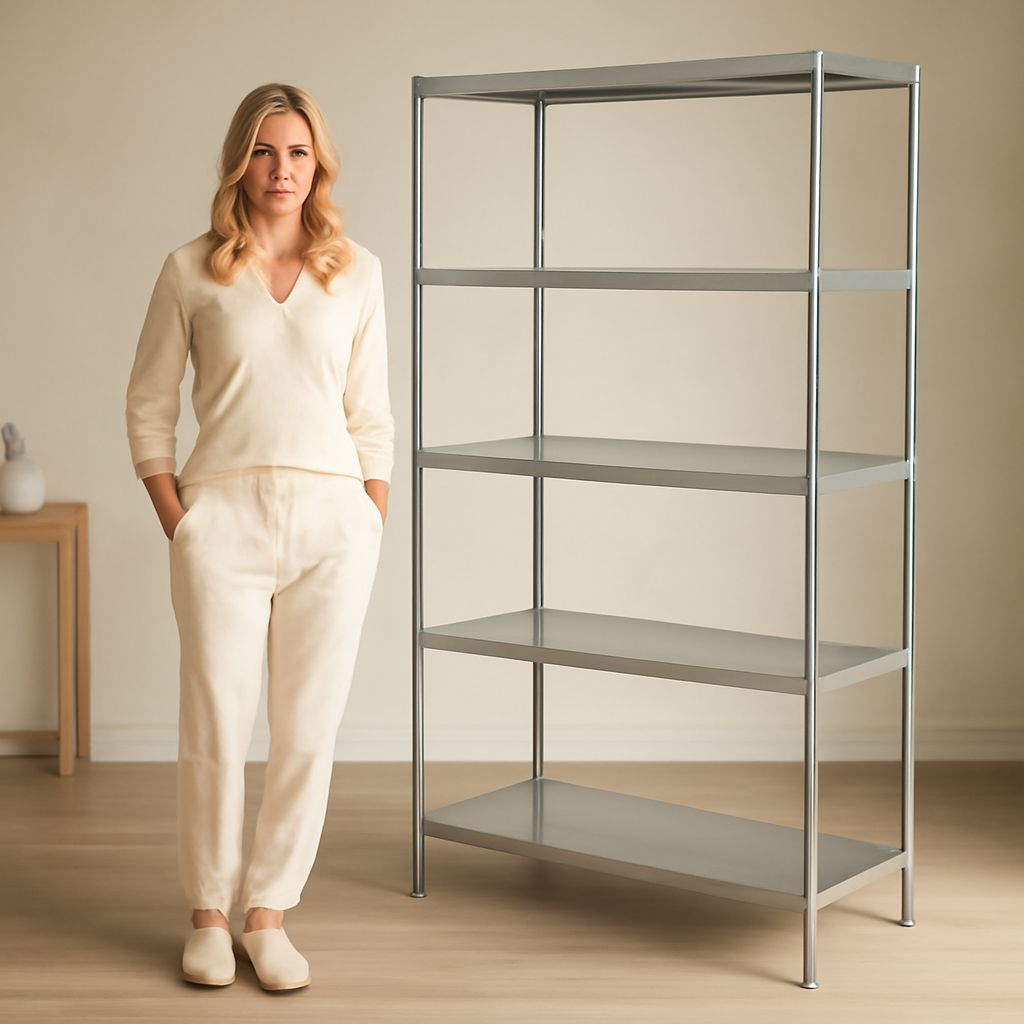
Choose a 304 stainless steel shelf for most kitchens, utility rooms, and indoor work areas. Choose 316 when salt, chlorides, or frequent exposure to brine and coastal air creates a higher corrosion risk. Use 430 in dry, low-exposure areas where cost matters more than maximum corrosion resistance.
For planning, allow about 12–18 inches of shelf depth, space wall brackets no more than 48 inches apart, and confirm the rated load for the complete assembly. Solid shelves suit spills and small items; wire shelves improve airflow and drainage. Select wall-mounted shelves when floor space is limited, or a freestanding unit when you need adjustable storage and mobility.
Stainless steel shelf types: wall, solid, wire, and freestanding
A wall-mounted stainless steel shelf attaches directly to a wall with brackets, standards, or concealed supports. It keeps the floor clear and works well above prep counters, sinks, appliances, and utility benches. The wall must support the shelf, brackets, fasteners, and stored contents together.
Freestanding shelving uses vertical posts, shelf clips, and adjustable levels. It offers more capacity and easier reconfiguration than wall storage. Add casters when staff need to move the unit for cleaning or layout changes. Locking casters are essential if the unit must remain stable during loading or use.
- Solid decks: Best for containers, liquid spills, flour bags, small tools, and items that could fall through wire.
- Wire decks: Improve ventilation, drainage, and visibility. They suit dry goods, dish racks, and areas where moisture must escape.
- Wall shelves: Save floor area but require accurate fixing into suitable wall structure.
- Freestanding units: Provide higher capacity, adjustable shelves, and easier access from both sides.
Check whether the shelf has a raised backsplash, front lip, or rolled edge. A backsplash prevents items and spills from reaching the wall. A rolled front edge stiffens the shelf and removes a sharp exposed corner. These features also make wiping safer and easier.
Stainless shelves: 304, 316, 430, brushed finish, and corrosion exposure
Grade 304 is the usual choice for indoor food-service areas, kitchens, utility rooms, and general workspaces. It provides good corrosion resistance and is widely available in solid and wire formats. It is not immune to staining, especially when salt, bleach residue, or acidic material remains on the surface.
Grade 316 contains added molybdenum, which improves resistance to chlorides. Specify it for coastal locations, salt storage, brine handling, frequent splash exposure, or cleaning regimes that introduce chlorides. It costs more, so use it where the exposure justifies the upgrade rather than treating it as necessary everywhere.
Grade 430 is commonly used for decorative or lower-exposure indoor applications. It can suit dry storage and areas with limited contact with water or chemicals. It is less suitable for damp, salty, or aggressively cleaned environments than 304 or 316.
A brushed finish has fine directional lines that reduce the visibility of light scratches and fingerprints. Clean it with the grain rather than across it. Brushing does not change the underlying grade, and it does not make a less suitable alloy resistant to salt or chlorine.
Before ordering, identify corrosion sources. Check for salt, bleach, chlorine sanitizers, acids, hard-water deposits, coastal air, iron dust, and contact with carbon-steel tools. Also check whether water can pool beneath containers or inside seams. The correct grade, finish, weld quality, and cleaning routine must match the exposure.
Stainless steel shelves for a kitchen: solid decks, wire decks, backsplashes, and rolled edges
For food preparation and wet cleaning, solid stainless steel shelves are usually the most practical option. They contain spills, support small containers, and provide a continuous surface for bins or equipment. A turned-down or rolled front edge improves stiffness and reduces the chance of cuts.
Choose wire shelving where airflow, drainage, and visibility matter more than spill containment. Wire decks are useful in dry stores, cool rooms, dishwashing areas, and racks holding pans or baskets. Use shelf liners only when small items need a stable surface, and choose liners that can be removed and washed.
A backsplash is useful behind sinks, preparation benches, and shelves installed near walls that must remain protected. A common backsplash height is 4–6 inches, although the right height depends on splash exposure and clearance above the work surface. Confirm that the backsplash will not interfere with outlets, taps, windows, or wall-mounted equipment.
For most kitchen storage, a 12-inch depth handles cans, containers, and smaller utensils. Choose 16–18 inches for larger pans, ingredient bins, or countertop equipment. Measure the usable shelf width between walls, posts, and adjacent equipment. Leave enough clearance to remove containers without scraping nearby surfaces.
Plan a stainless steel shelving unit: dimensions, brackets, posts, adjustable shelves, and casters
Start with the stored items, not the shelf catalogue. Measure the largest container, add clearance for hand access, and allow space for doors, pipes, ventilation, and cleaning. A typical freestanding unit is 18–72 inches wide and 12–24 inches deep. Taller units need greater attention to stability and anchoring.
Set shelf spacing around the contents. Allow 2–4 inches above the stored item for easy removal, then use adjustable shelves to reduce wasted vertical space. Adjustable clips or pins should lock positively into the posts. Avoid placing a heavy shelf on a partially engaged clip.
Wall brackets should be selected for the shelf depth and intended load. Space them closer together for deep shelves, heavy containers, or weaker shelf construction. As a general planning limit, use bracket spacing of 24–36 inches for heavier loads and up to 48 inches for lighter, evenly distributed storage. The manufacturer’s rating overrides these planning ranges.
For freestanding units, use posts with compatible shelf collars and secure the frame against tipping where necessary. Casters add mobility but reduce stability and may lower the safe load. Select industrial casters with brakes, sufficient capacity, and wheels suited to the floor surface.
Load ratings usually assume an evenly distributed load, not one heavy object at the center or edge. Put dense items over posts or brackets, keep heavy goods on lower shelves, and distribute containers across the full deck. Include the weight of liners, bins, and equipment when calculating the total.
Install, clean, and maintain: fasteners, wall substrates, leveling, load distribution, and care
Identify the wall substrate before choosing fasteners. Timber framing requires structural screws driven into studs. Masonry requires anchors rated for the block or concrete. Tile over drywall is not a structural substrate by itself. For hollow walls, use a suitable backing system or open the wall and install blocking.
Mark bracket positions with a level, drill to the anchor manufacturer’s requirements, and tighten without distorting the shelf. For a freestanding unit, assemble every post and shelf connection fully, then level the frame on the floor. Use adjustable feet or approved shims; do not rely on loose objects beneath the posts.
- Remove packaging film and inspect welds, corners, brackets, and shelf clips.
- Clean the wall or floor contact area before final installation.
- Level the unit from front to back and side to side.
- Load the lowest shelves first, then distribute weight across the frame.
- Test movement and brakes if the unit has casters.
Clean stainless surfaces with warm water, mild detergent, and a soft cloth. Rinse away detergent and dry promptly to prevent water marks. Wipe brushed surfaces in the direction of the grain. For wire decks, clean around welds and intersections where food residue can collect.
Do not use steel wool, carbon-steel brushes, or abrasive powders. Avoid leaving bleach, chlorine sanitizer, salt, acidic food, or harsh descaler on the surface. If corrosion or tea-colored spotting appears, remove the source, rinse thoroughly, and use a stainless-safe cleaner according to its instructions. Inspect fasteners, brackets, welds, casters, and floor contact points periodically for looseness, trapped moisture, or rust transfer.