
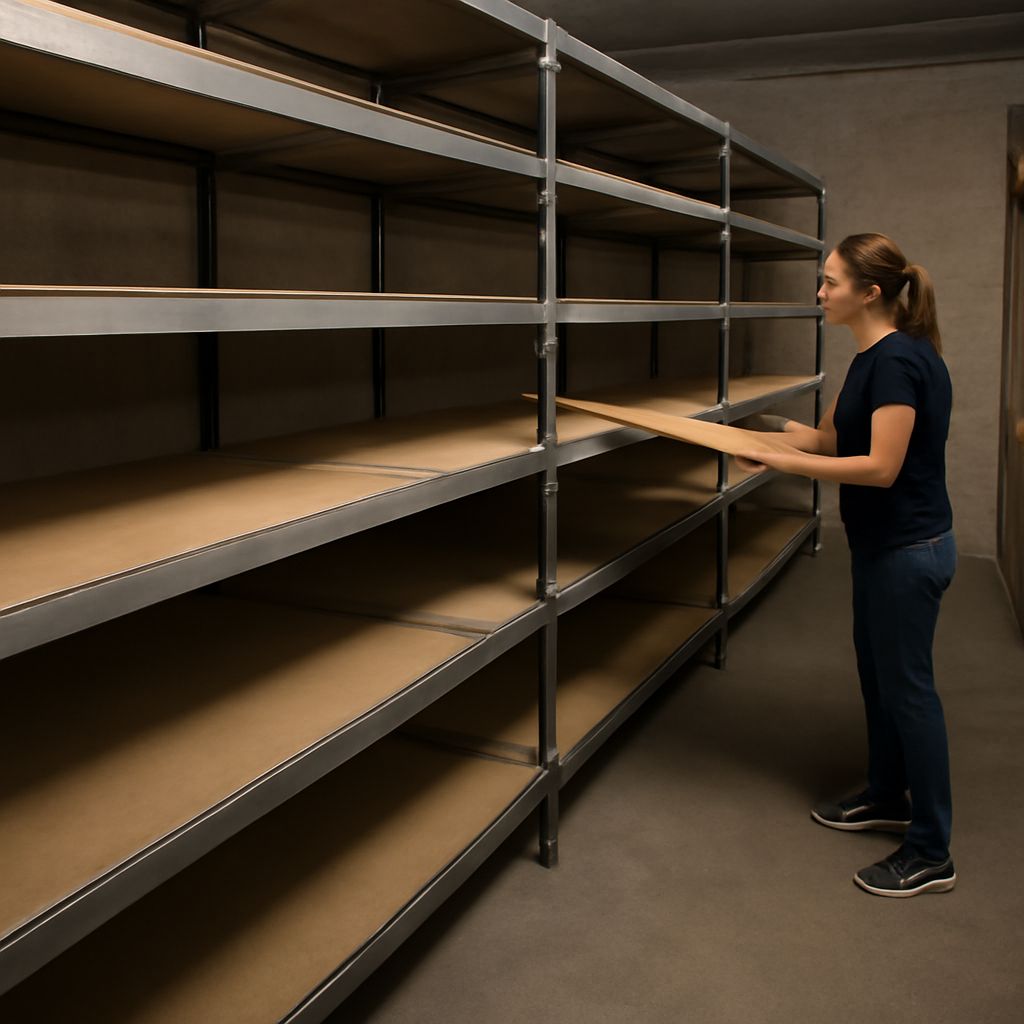
Choose industrial shelves by matching the stored inventory, handling method, and available floor space. For most stockrooms and workshops, adjustable steel clip, boltless, rivet, wire, or long-span units offer more practical access than pallet rack.
The right industrial metal shelving configuration starts with item dimensions and access frequency. Then specify the bay width, shelf depth, decking, load ratings, finish, anchoring, aisle clearance, and room for future changes.
Industrial Shelves: Compare Steel Clip, Boltless, Rivet, Wire, and Long-Span Types
Steel clip shelving uses formed shelves that attach to upright posts with clips. Shelves adjust quickly, making this format useful for cartons, parts bins, and changing stock. It suits light- to medium-duty hand loading when clean access and easy reconfiguration matter.
Boltless shelving uses riveted beams or connectors that lock into upright frames without standard bolts. Assembly is fast, and shelves can often be repositioned with a mallet. Check the manufacturer’s assembly method and required bracing, particularly for taller bays.
Rivet shelving generally uses horizontal beams that fit into rivet slots on upright posts. It offers a strong, economical structure for cartons, containers, and workshop supplies. Some rivet systems accept particleboard, wire, or steel decking.
Wire shelving improves visibility, airflow, and drainage. It works well for cleanrooms, storerooms, food-service areas, and inventory that benefits from ventilation. Small items may require shelf liners or bins so they do not fall through the grid.
Long-span shelving provides wider shelves for bulky cartons, furniture components, tubing, or larger totes. Wider spans can increase deflection, so verify the rating for the complete shelf width and decking combination. For palletized goods handled by forklifts, use purpose-designed pallet rack instead. Pallet rack is engineered around pallets, beams, lift-truck clearances, and system bracing; shelving is typically hand-loaded and organized around individual items or containers.
Industrial Metal Shelving: Span, Decking, Finish, and Adjustment
Measure the clear span between supports, not simply the overall bay width. A longer span places more demand on beams and decking. Select shelf depth from the item’s front-to-back measurement, then leave enough clearance for labels, hands, and safe retrieval.
Decking affects both capacity and usability. Steel panels provide a durable, cleanable surface. Wire decks improve airflow and visibility. Particleboard or laminated panels can offer a smooth surface for cartons, but they need protection from moisture and damage.
Confirm whether the system adjusts by clips, slotted beams, bolts, or another connector. Frequent inventory changes favor tool-free or quick-adjust designs. Set shelves so heavy items remain between comfortable handling heights, while rarely accessed stock occupies higher positions.
Finish selection depends on the environment. Powder coating suits ordinary indoor stockrooms and workshops. Galvanized or otherwise corrosion-resistant components are better for damp, humid, or washdown areas. Address leaks, condensation, chemicals, and damaged coatings before they weaken steel components.
Inventory Dimensions and Shelf/Bay Load Ratings
Start with an inventory list. Record each item’s length, width, height, weight, packaging, tote dimensions, quantity per shelf, and access frequency. Add clearance above each item so staff can remove it without lifting into the shelf above.
Specify both shelf and bay ratings. A per-shelf rating describes the maximum load on one shelf under stated conditions. A per-bay rating describes the combined allowable load across the complete unit, often with limits on shelf count, spacing, and frame height. Neither rating should be treated as universal.
Distinguish point load from distributed load. A distributed load spreads weight across the shelf surface. A point load concentrates weight in a small area and may require stronger decking or additional support. Ratings commonly assume evenly distributed loads, so compare your actual storage pattern with the manufacturer’s stated configuration.
Check the rating for the exact bay width, shelf depth, span, number of shelves, connector type, and decking material. Do not add shelf ratings together unless the listed bay rating permits that arrangement. Heavy items belong on lower shelves to reduce handling risk and improve stability.
Heavy-Duty Shelving Units: Layout, Aisles, Anchoring, and Expansion
Sketch the room before ordering. Mark doors, columns, electrical panels, sprinkler equipment, windows, and floor obstructions. Place shelving so workers approach items squarely and can read labels without reaching across adjacent bays.
Size aisles for the actual handling method. Hand-loaded shelving needs comfortable clearance for people, carts, and tote movement. Powered equipment requires a wider, engineered aisle based on the vehicle and turning path. Never use a pedestrian aisle as a staging area.
Inspect the floor for levelness, cracks, moisture, and adequate strength. Level uneven bays with approved methods rather than improvised packing. Anchor tall or heavily loaded units when required by the manufacturer, site conditions, or local safety rules. Add back-to-wall restraints, row spacers, or seismic protection where the design calls for them.
Protect exposed ends and corners from carts and lift equipment. Use end guards, posts, bollards, or barriers where impact is possible. Label each bay’s permitted load, inspect damaged uprights and beams, and remove compromised components from service.
Allow for expansion by standardizing bay widths, shelf depths, connectors, and decking. Reserve wall or floor space for another bay, and confirm that replacement parts and compatible add-on sections are available. A practical specification checklist includes:
- Item and tote dimensions, weights, quantities, and retrieval frequency
- Bay width, shelf depth, clear span, shelf count, and adjustment method
- Per-shelf and per-bay ratings for the selected configuration
- Decking type, corrosion protection, and required accessories
- Floor condition, anchoring, impact protection, and aisle dimensions
- Future add-on bays, shelf changes, and inventory growth