
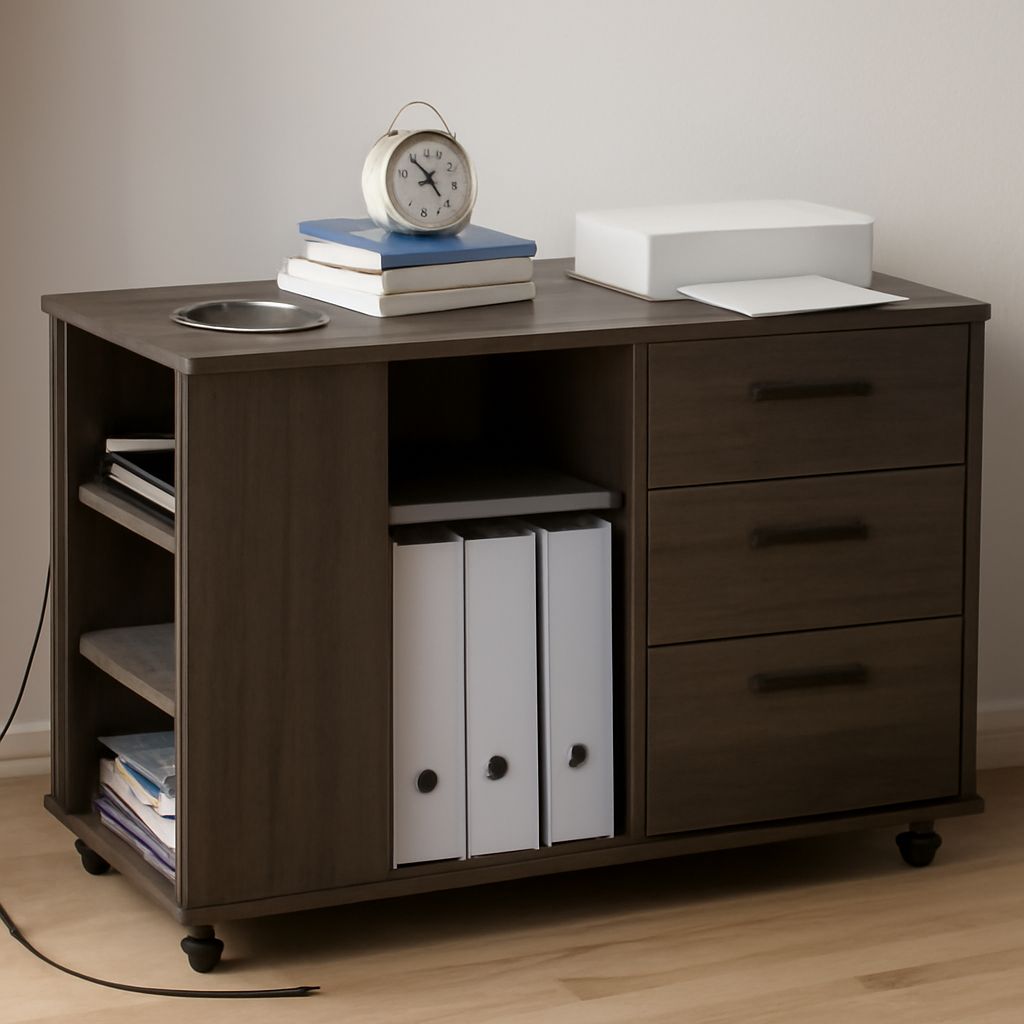
A three-drawer file cabinet should match your files, available floor space, and filing habits. Choose a vertical model for front-to-back filing, a lateral model for side-to-side access, a pedestal for under-desk storage, or a mixed-drawer design when supplies and files share one cabinet.
Before comparing finishes, check usable drawer dimensions rather than outside dimensions. Confirm the cabinet accepts letter or legal folders, opens fully, and includes the stability and security features your office requires.
Three-drawer file cabinet formats
Each format uses three drawers differently, and not every cabinet contains three full-height filing drawers.
- Vertical: A narrow, taller cabinet usually stores folders front-to-back. It suits offices with limited wall width and moderate daily access.
- Lateral: A wider, lower cabinet stores folders side-to-side. It offers a broad view of labels and can double as a work surface, but needs more wall width.
- Pedestal: A compact unit fits under or beside a desk. Counter-height pedestals can support a desktop or return, while casters make repositioning easier.
- Mixed-drawer: One or more drawers may hold files, with the remaining drawers sized for stationery, tools, or personal items. Check each drawer’s height and hardware.
Three-drawer file cabinets: vertical, lateral, pedestal, or mixed
Use the room and the filing workload to narrow the choice. A vertical cabinet generally gives you more filing capacity in a smaller footprint. A lateral cabinet provides faster visual scanning and easier access when several people share files. A pedestal keeps active records close to one workstation.
Compare capacity by usable width, depth, and height inside each drawer. Outside dimensions include the cabinet shell, drawer fronts, handles, trim, casters, and any anti-tip base. Usable dimensions describe the space available for folders, rails, and dividers. Those measurements determine whether the stated capacity is practical.
For high-volume records, check the manufacturer’s filing capacity and maximum load for each drawer. A narrow cabinet may fit three drawers but hold fewer folders than a wider lateral model.
File cabinet with three drawers: letter or legal, front-to-back or side-to-side
Letter files hold documents measuring 8.5 by 11 inches; legal files measure 8.5 by 14 inches. Select rails designed for the file size, not merely a cabinet described as “file storage.” Some drawers accept one size only, while adjustable or reversible hanging rails support both.
- Front-to-back filing: Common in vertical cabinets. Folders line up from the front toward the rear, using less wall width but requiring more reach.
- Side-to-side filing: Common in lateral cabinets. Folder labels face the user across the drawer width, making browsing quicker.
- Hanging rails: Keep folders upright and prevent them from sliding. Verify rail position, spacing, and compatibility with letter or legal folders.
- Follower blocks: Hold a partly filled row upright. They reduce folder slumping and make retrieval easier as records are removed.
Check whether the drawer is a true filing drawer or a shallow utility drawer. A file drawer should leave enough vertical clearance for hanging folders without crushing tabs.
Construction, access, locks, fire resistance, and anti-tip safety
Steel construction generally resists dents and supports heavier loads, while powder-coated finishes help protect against everyday wear. Examine drawer joints, suspension hardware, and the smoothness of the slides.
Full-extension slides bring the rear of the drawer forward, allowing access to the entire file row. Partial-extension slides leave records at the back harder to reach. Ball-bearing slides usually support frequent use, but their rated load matters more than the label alone.
A lock may secure all drawers through one central mechanism, or protect only selected compartments. Confirm whether the lock is included, removable, or keyed alike for multiple cabinets. Fire resistance is a separate feature from ordinary steel construction. If protecting irreplaceable records matters, look for a tested fire-rated product and its stated rating.
For stability, choose a cabinet with an anti-tip interlock that prevents multiple drawers from opening at once. Load the lowest drawer first, keep heavy materials low, and use the supplied wall anchor when one is provided. Casters add mobility but can reduce stability unless they lock securely.
Measure placement, clearance, floor level, and loading
- Measure the location: Record available width, height, and depth. Include baseboards, handles, door swings, desk legs, and electrical outlets.
- Check opening clearance: Leave enough space for the drawer to extend fully and for your body to stand comfortably in front. Do not place a cabinet where an open drawer blocks an exit or walkway.
- Confirm fit: For a wall position, compare the cabinet’s outside depth with the room’s usable depth. For under-desk use, measure clearance beneath the worksurface, including knees, modesty panels, and cables.
- Level the cabinet: Set it on a firm, level floor. Adjust leveling feet where available; an uneven cabinet can cause drawers to bind or roll unexpectedly.
- Label and load: Label folders consistently, keep active records within easy reach, and distribute weight across drawers. Do not exceed the stated drawer or cabinet capacity.