
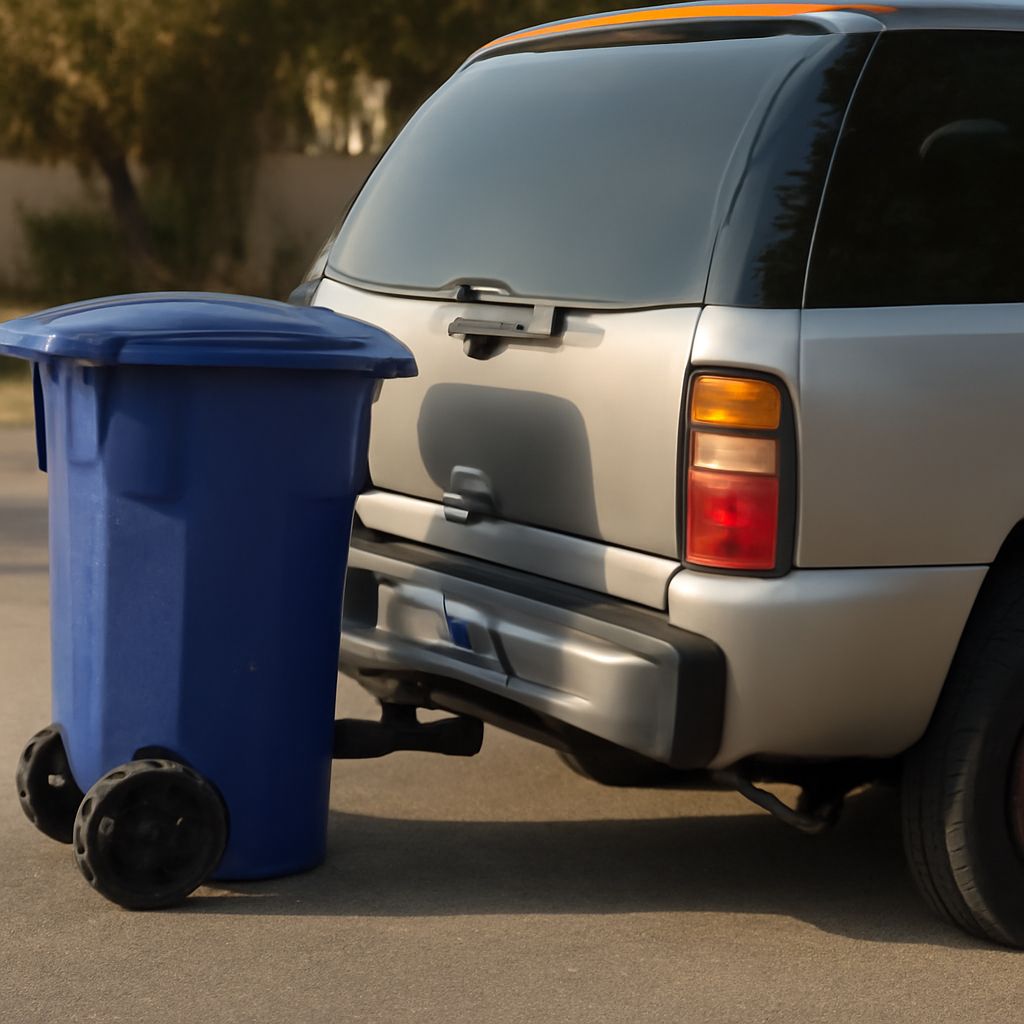
A trash can with wheels simplifies curbside collection, yard cleanup, and moving waste around a property. The best choice depends on capacity, route surface, collection equipment, and storage space.
Two-wheel carts suit most homes because they tilt and roll over short distances. Four-wheel carts are steadier for larger loads and flat surfaces, but they need more parking space and handle curbs poorly.
Trash Can With Wheels Formats: Two- and Four-Wheel Carts
Two-wheel carts usually have a molded body, a rear handle, and one fixed axle. You pull the handle toward you, balance the load over the axle, and roll the cart on its two large wheels. This design works well on driveways, sidewalks, and lawns.
Four-wheel carts use two fixed or swivel wheels, or four casters, under the container. They remain upright while being pushed and are useful for apartment compounds, workshops, and commercial waste stations. Swivel casters improve maneuverability, while fixed wheels track better over longer straight routes.
Wheel diameter commonly ranges from about 8 to 12 inches. Larger wheels cross grass, gravel, and driveway cracks more easily. A steel axle generally handles repeated heavy loads better than a thin molded axle. Solid plastic wheels resist flats; rubber-tread wheels roll more quietly but may cost more.
Choose Capacity and Outside Dimensions
Household cart capacities commonly include 32, 64, and 96 gallons. A 32-gallon cart suits a small household or limited weekly waste. A 64-gallon cart fits many families, while a 96-gallon model handles high-volume waste but becomes difficult to move when full.
Typical outside dimensions are approximately 24 by 24 by 36 inches for a 32-gallon cart, 26 by 31 by 42 inches for a 64-gallon cart, and 28 by 34 by 47 inches for a 96-gallon cart. Actual dimensions vary, so measure the complete cart, including its lid, wheels, and handle.
- Check that the cart passes through gates, doors, and narrow side yards.
- Leave room to grip the handle and turn the cart into its parking position.
- Choose tapered bodies if you need carts to nest during storage.
- Do not fill beyond the rim; an overfilled cart may not close or lift safely.
How Trash Cans With Wheels Handle the Route
A high, rounded handle gives better leverage for tilting a two-wheel cart. A low center of gravity reduces strain when the container is full. Look for a handle that feels rigid, has enough hand clearance, and does not flex away from the body.
Two-wheel cans generally manage a curb better than four-wheel cans because you can lift the front edge and roll over it. Neither format is convenient on stairs. Use a smaller load, a ramp, or a hand truck rather than dragging a full cart down steps.
On slopes, a full cart can accelerate quickly. Choose a model with a parking brake if available, or store it on level ground with the lid facing uphill. Four-wheel carts are especially vulnerable to rolling sideways on uneven slopes.
Before buying, check your collection rules. Automated systems may require a specific cart size, lid shape, handle position, lifting bar, or side-lifter compatibility. A privately purchased cart is not automatically compatible with every municipal truck. Keep the lid closed, position the approved cart as directed, and avoid attachments that interfere with the lifting mechanism.
Choose the Lid, Storage Footprint, and Cleaning Routine
A tight-fitting hinged lid helps contain odors, rain, and animals. Look for a strong hinge with a stop that prevents the lid from swinging backward. A locking or animal-resistant lid helps deter raccoons and dogs, but it should still open easily for collection crews.
Measure the storage footprint with the lid open if the cart will sit beneath a roof or inside a shed. Tapered carts can nest, but wheel housings and protruding handles may limit the stack depth. Park carts where they will not block walkways, gates, or vehicle access.
Clean the container after leaks or food spills. Empty it, rinse from top to bottom, scrub with detergent, and rinse again. Disinfect when needed, then let it dry with the lid open. Never mix bleach with ammonia or other cleaners.
Garbage Cans With Wheels for Homes, Yards, Workshops, and Shared Properties
- Households: Choose a 64-gallon two-wheel cart when weekly waste is moderate. Select the municipality’s approved model for automated pickup.
- Yard work: Use a large-wheel cart for leaves and light clippings. Confirm local rules before placing yard waste in a regular garbage cart.
- Workshops: Choose a durable two-wheel cart for a route across floors and driveways. Use separate, approved containers for chemicals, oils, batteries, and sharp materials.
- Shared properties: Four-wheel garbage cans with wheels work well at level collection points. Prioritize brakes, reinforced axles, replaceable casters, clear labels, and enough space for safe parking.