
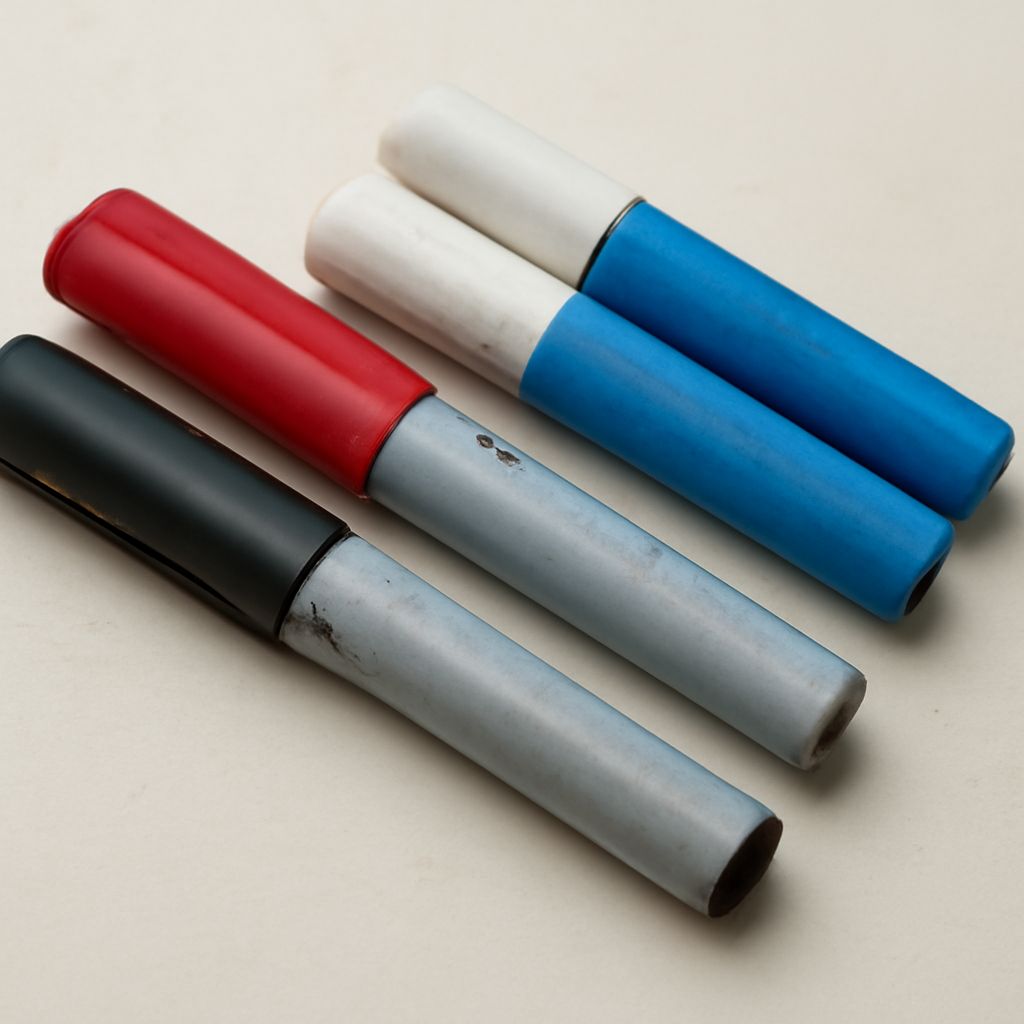
To learn how to revive dry-erase markers, first decide whether the problem is a dry tip, poor ink contact, a clogged nib, or an empty reservoir. Most weak markers recover through controlled steps rather than added liquid.
Check the cap, shake the marker, restore ink contact, and test it before attempting any nib treatment. Stop if the nib is damaged or the reservoir appears empty.
Diagnose Why the Marker Is Weak: Cap, Tip, Ink, or Empty Reservoir
Start with the cap history. If the cap was loose, missing, or left off, the exposed nib may have dried while usable ink remains inside. A cap that clicks or seals firmly helps prevent solvent from evaporating between uses.
- Dry tip: The nib feels hard, looks pale, or produces a faint line that improves briefly with pressure.
- Poor ink contact: The nib looks normal, but the marker writes weakly after being stored horizontally or tip-up.
- Clogged nib: The tip feels unusually stiff or produces broken lines despite ink movement inside the barrel.
- Empty marker: Several recovery attempts produce no sustained color, and the marker feels unusually light or sounds dry when gently shaken.
Do not judge the marker from one short stroke. Make a slow scribble on a whiteboard for 15 to 20 seconds, then wipe it clean. This initial scribble test shows whether ink reaches the nib gradually or not at all. Examine the tip afterward for splitting, fuzz, flattening, or embedded board residue.
How to revive a dry-erase marker safely: Restore ink contact
Replace the cap tightly, then shake the marker for 10 to 15 seconds. Shaking redistributes pigment and solvent, but it does not refill a genuinely empty reservoir. Keep the cap on while shaking so the nib is not exposed to more air.
- Hold the marker with its nib pointing downward.
- Tap the capped marker gently against your palm once or twice.
- Leave it tip-down for five to 10 minutes.
- Remove the cap and draw slow lines without pressing hard.
The tip-down rest lets liquid ink move toward the nib by gravity. If the first lines are faint, continue with controlled strokes for 20 to 30 seconds. Avoid repeatedly mashing the nib into the board; excessive pressure can deform the fibers and create a permanent leak or fuzzy line.
If the marker was stored tip-up, this orientation step may restore it. If it was capped but still weak, rotate it between your hands, shake again, and repeat the short tip-down rest once. A marker that remains completely dry after these attempts may have a blocked feed or no usable ink left.
Rewet or Turn a Compatible Nib With Minimal Matching Solvent
Only use this section when the marker has a removable or reversible nib and is clearly designed for that access. Do not pull the tip from a sealed, glued, or unknown marker design. Tip removal can damage the feed, release ink, or make the marker impossible to reseal.
For a compatible marker, remove the nib according to its design and inspect both ends. Some nibs can be turned around to place a less-used end outward. Reverse it only if the nib is symmetrical and intended to be reversible; never force a shaped or permanently fixed tip.
If the manufacturer identifies a refill solvent, use only a minimal amount that matches the marker’s ink family. For a compatible refillable design, one or two drops on the nib or feed is usually enough to test rewetting. Do not add water, rubbing alcohol, acetone, or another household liquid simply because it is available. The wrong solvent can separate the ink, damage the barrel, or make the marker write poorly.
Reinsert the nib in its original orientation, seat it firmly, and replace the cap. Let the marker rest tip-down for several minutes before testing. If the nib remains frayed, split, or hard after rewetting, replacement is more reliable than further treatment.
Test the Final Line, Store It Capped, or Replace It
Finish with a clean whiteboard test. Draw one continuous line, then several quick strokes and a small loop. The marker is usable when the color is even, the line does not skip, and the nib springs back without shedding fibers. Wipe the test away while it is fresh; a damaged ink formula may leave staining or ghosting.
If the final line is still faint after shaking, tip-down resting, and an approved nib treatment, treat the marker as spent. An empty reservoir, permanently clogged feed, leaking barrel, or frayed nib is a clear stop cue. Do not keep adding solvent to compensate for missing ink.
- Cap the marker immediately after every use and press the cap fully into place.
- Store it horizontally for routine storage, or tip-down briefly when the ink contact is weak.
- Keep markers away from heat and direct sunlight, which can accelerate solvent loss.
- Store different ink systems separately and use the marker’s original cap.
These habits help revive dry-erase markers less often because they preserve the cap seal, nib moisture, and ink flow from the start.