
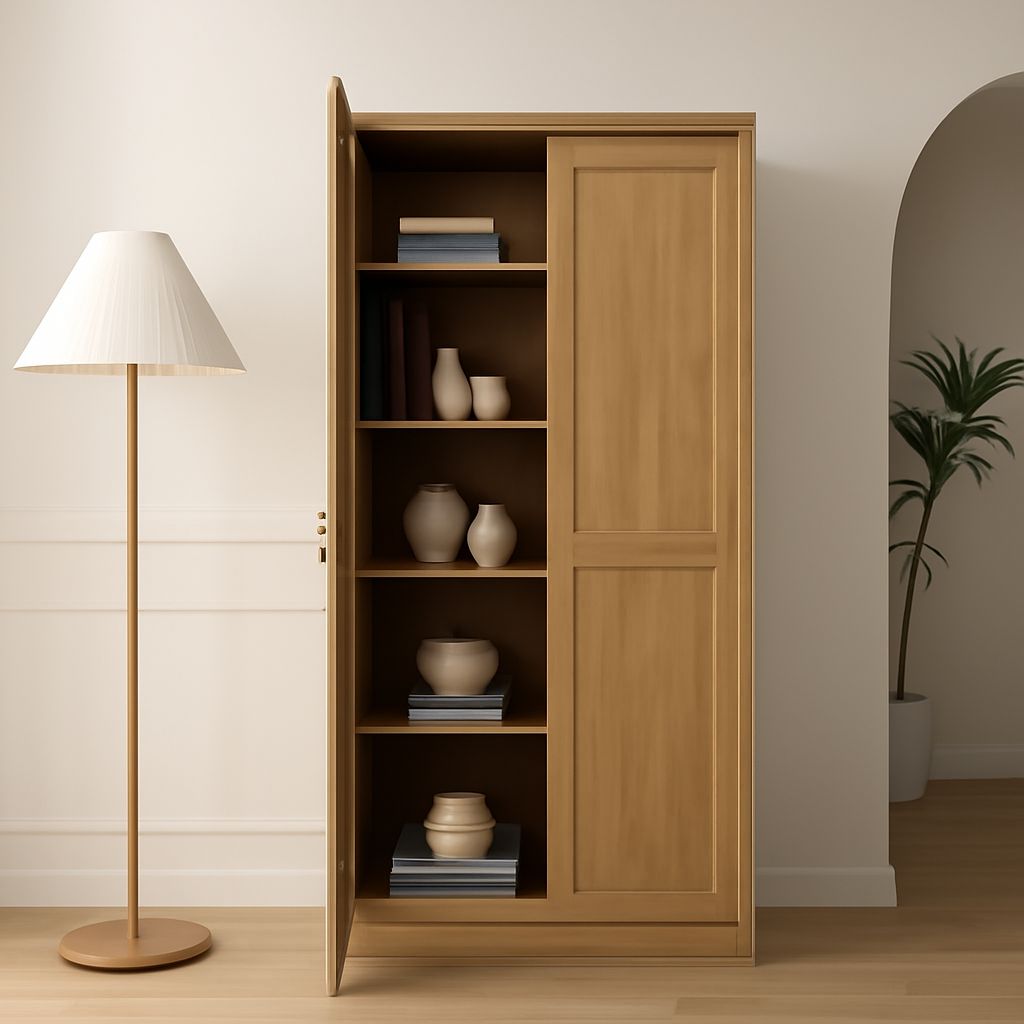
Choose a solid wood storage cabinet by verifying which parts are solid lumber, then match its dimensions, shelf capacity, and door movement to your room. A cabinet made from solid oak or maple throughout its structural parts offers durability, but stable plywood panels and a hardwood frame can also provide excellent household storage.
For tall wood storage cabinets with doors, measure the delivery route and the final location before comparing finishes or hardware. The most useful checks are construction, usable depth, adjustable shelving, hinge quality, floor stability, and safe wall restraint.
Solid Wood Storage Cabinet Construction: True Solid Wood or Mixed?
“Solid wood” should describe the cabinet components, not simply its appearance. A true solid-wood cabinet may use oak, maple, cherry, walnut, or pine for the frame, doors, side panels, shelves, and structural rails. Species affect hardness, grain, weight, color, and price. Oak and maple usually withstand frequent use well, while pine is lighter and softer.
Inspect the specification for each component. Some cabinets have solid-wood face frames and doors but use veneer over plywood, medium-density fiberboard, or particleboard for the sides and top. That is mixed construction, not an entirely solid-wood cabinet. It is not automatically inferior: quality plywood often stays flatter than a wide solid panel and reduces seasonal movement.
The back deserves particular attention. A thin fiberboard back may work for lightweight linens, but a screwed or captured plywood back contributes more rigidity. Solid shelves are attractive, yet plywood shelves with hardwood edging can resist bowing and remain dimensionally stable. Ask whether shelves are supported across their full depth and whether the cabinet has a center divider for long spans.
Solid wood expands and contracts as humidity changes. Good construction allows that movement with floating door panels, elongated fastener holes, and sensible gaps around doors. Gluing every edge of a wide panel can cause cracking or joint failure. A cabinet that uses stable panels where appropriate, strong joinery, and a well-attached back may outperform a heavier cabinet assembled without room for movement.
Choose Dimensions for Tall Wood Storage Cabinets With Doors
A practical tall cabinet commonly measures about 72 to 84 inches high, 30 to 40 inches wide, and 16 to 20 inches deep. Treat these as starting ranges, not fixed standards. Confirm the external dimensions, then calculate the usable interior after subtracting the back, doors, frame, and shelf thickness.
Usable depth matters more than the published depth. An 18-inch-deep cabinet may provide only 14 to 16 inches inside. That suits folded clothing, books, pantry containers, towels, and office supplies. Deeper interiors hold bulky appliances or baskets, but they can hide small items and place more weight toward the front of the shelves.
- Measure the room: Record ceiling height, available width, baseboard depth, nearby trim, and the space needed for the doors to open.
- Measure the delivery route: Check the cabinet, packaging, doorway, hall, stair, elevator, and tight turns. Compare the narrowest opening with the cabinet’s smallest orientation.
- Plan item clearances: Allow height for baskets, binders, bottles, or appliances rather than relying on the number of shelves alone.
- Match the load: Books, cookware, tools, and dense records need stronger shelves than linens or occasional décor.
Adjustable shelves make a cabinet more useful over time. Look for multiple shelf-pin positions, solid metal pins, and holes extending through most of the storage area. A fixed shelf can strengthen the case, but every shelf should not be permanently fixed if the cabinet will store changing household items. For heavy loads, favor thicker shelves, shorter spans, a center divider, and closely spaced supports.
Inspect Doors, Shelves, and Joinery in Wood Storage Cabinets
Open every door and examine its movement. Doors should hang evenly, meet without rubbing, and remain aligned when opened halfway. Small seasonal changes are normal in solid wood, but persistent binding, large gaps, or a door that swings open by itself can indicate poor alignment or an uneven cabinet.
Soft-close concealed hinges provide a clean appearance and often allow adjustment from side to side, front to back, and vertically. Traditional butt hinges can be durable when properly fitted, while inexpensive hinges may sag under heavy doors. Check the hinge count, screw attachment, adjustment range, and whether replacement hardware is available.
Look closely at the door construction. A frame-and-panel door should have tight, clean joints and a panel that can move naturally within the frame. Mortise-and-tenon, dowel, and well-executed pocket or screw joinery can all work; loose joints, visible gaps, excessive glue, and staples used as the primary structural connection are warning signs.
Check the cabinet corners, frame, back, and shelf supports from inside. Dovetails are useful for drawers, while reinforced corner blocks, dowels, mortise-and-tenon joints, or properly fastened screws can secure a cabinet body. The back should be square to the case. If the cabinet racks when pushed diagonally, it needs better bracing or a stronger back.
Finish quality affects both appearance and maintenance. A clear finish should be even without cloudy patches, rough dust, missed edges, or heavy drips. Oil finishes highlight grain but may need more maintenance. Water-based and catalyzed finishes can offer stronger everyday resistance. No finish makes wood waterproof, so inspect exposed end grain and keep standing moisture away.
Run your hand along shelf edges, door corners, and the interior. Surfaces should be smooth but not excessively slippery, and the smell should not be overpowering in a normally ventilated room. Confirm that shelf pins seat fully and that shelves cannot easily lift or tip when a door is opened.
Place, Level, and Maintain the Cabinet
Before delivery, confirm whether the cabinet arrives assembled. Measure the packaged dimensions if supplied, because protective cartons can be wider or taller than the furniture. Plan the route through the doorway, including door removal, stair landings, ceiling height, and the ability to turn the cabinet upright. Never assume a cabinet that fits the room will fit through the entrance.
Set the cabinet on a level floor. Use appropriate shims beneath the base rather than forcing the doors into alignment. Recheck the gaps after leveling, then secure a tall cabinet to a wall stud or suitable masonry anchor using the manufacturer’s restraint hardware. Wall restraint is especially important when shelves hold dense items or children can access the doors.
Check the door swing against walls, handles, adjacent furniture, and baseboards. A deep baseboard can hold the cabinet away from the wall and alter how far the doors open. Leave enough clearance to remove shelves and reach the rear of the interior. If two cabinets sit together, open each door fully before final positioning.
Keep the cabinet in a stable indoor environment, away from radiators, heating vents, damp exterior walls, and direct sunlight. Sudden humidity changes increase wood movement and can affect doors, joints, and finish. Use coasters or liners where useful, wipe spills promptly with a slightly damp cloth, and avoid abrasive cleaners or soaking the wood.
Load lower shelves with the heaviest suitable items, distribute weight across the shelf, and stay within the maker’s stated capacity. Recheck shelf pins, hinge screws, level, and wall restraint after the first few weeks and whenever the cabinet is moved.