
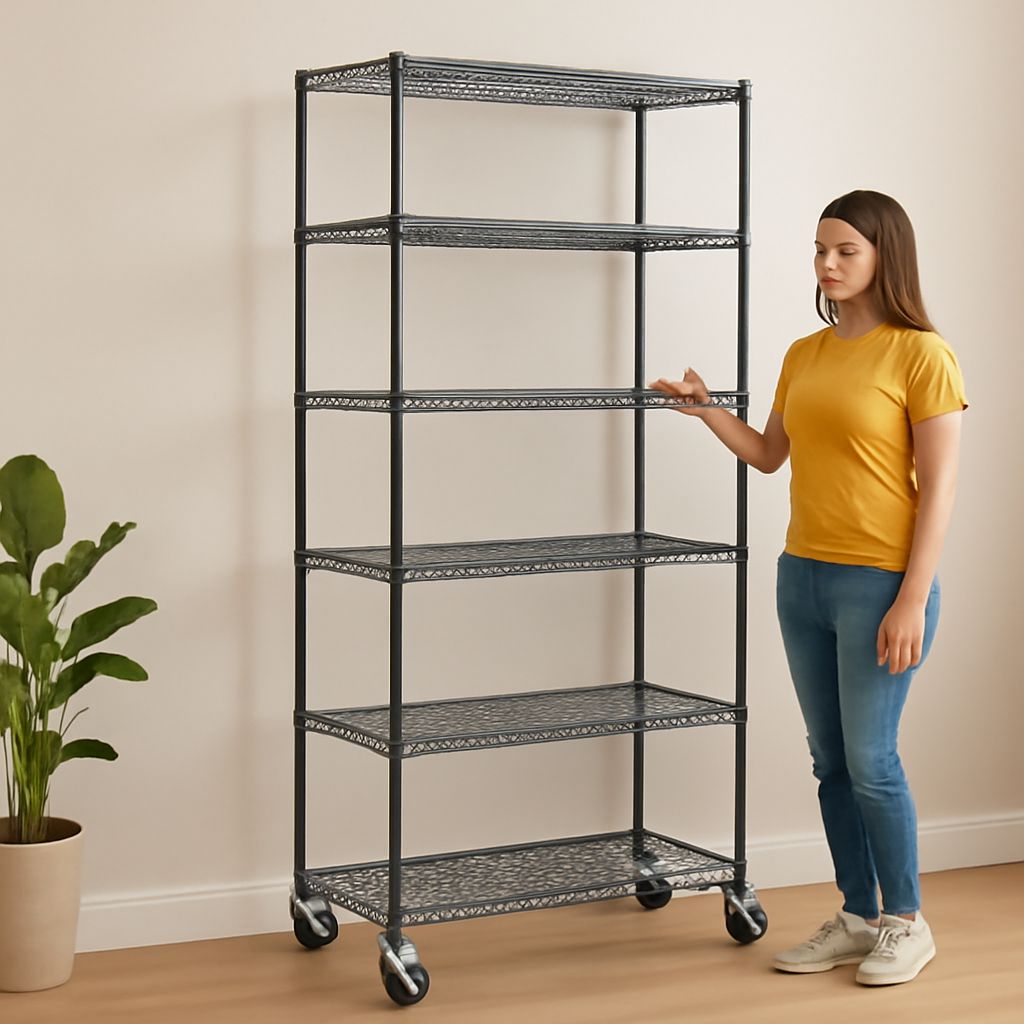
Steel shelves are the best starting point for hand-accessed storage, while pallet rack suits forklift-handled loads. Choose solid or wire shelving for small goods, boltless or rivet units for flexible workshop and stockroom storage, long-span shelving for bulky cartons, and pallet-oriented racking for heavy, standardized pallets. Base the choice on item size, load, retrieval frequency, environment, floor condition, and future expansion.
Before ordering, record the required bay width, shelf depth, overall height, clear openings, and heaviest load per level. Then compare the manufacturer’s shelf and bay ratings using the same load assumptions.
Steel shelves: compare solid, wire, boltless, rivet, and clip systems
Each shelving format solves a different access and load problem:
- Solid steel shelving: A closed deck supports small parts, cartons, tools, and loose items without gaps. It also contains minor spills, but it blocks airflow and visibility below each level.
- Wire shelving: Open wire decks improve visibility, ventilation, and sprinkler-water penetration. They suit storerooms, food-service areas, clean rooms, and damp locations when the finish is appropriate. Use liners or bins for very small parts.
- Boltless shelving: Uprights and beams connect with tab-and-slot or rivet-style joints, so assembly needs little hardware. Levels adjust quickly, making this a practical choice for garages, workshops, and stockrooms.
- Rivet shelving: Riveted beam connections create a robust, hand-loaded bay. Many rivet units use particleboard, plywood, or steel decks and offer good capacity for cartons and containers.
- Clip shelving: Clips, hooks, or tabs secure shelves to slotted posts. This format is often lighter and especially convenient when shelf height changes frequently. Confirm that the clips lock fully and match the post system.
Terminology overlaps between suppliers. Some products marketed as boltless shelving use rivet connections, while clip systems may use similar slotted uprights. Inspect the joint, deck, and adjustment method rather than relying on the label alone.
Choose a steel shelf for long-span or pallet-oriented storage
A standard steel shelf usually supports hand-loaded items across a moderate-width level. A long-span steel shelf has wider beams and deeper decks for bulky cartons, bins, furniture parts, or low-volume stock. It reduces the number of uprights, but its wider span makes beam strength and deck support more important. Use a center support or additional beam when the specified span cannot carry the load without excessive deflection.
Long-span units work well when people retrieve products from floor level or a step platform. They are not automatically suitable for pallets. Pallet loads concentrate weight on beams and require enough clearance for forks, pallets, and handling equipment.
Pallet-oriented systems use upright frames, horizontal beams, and often wire or steel pallet supports. Selective pallet rack gives direct access to every pallet position, but it consumes more floor space than dense storage systems. Drive-in, push-back, or other high-density arrangements reduce access frequency and require compatible pallets and handling equipment.
Use pallet rack when goods arrive in consistent unit loads and are moved with forklifts or pallet jacks. Do not place a loaded pallet on ordinary hand-loaded shelving unless the unit is specifically rated and configured for that purpose.
Read shelf and bay ratings and dimensions for a steel storage rack
Ratings are meaningful only when their scope is clear. A shelf rating normally describes the maximum load on one level, commonly assuming an evenly distributed load across the deck. A bay rating describes the total permitted load for the complete unit or a group of levels. Do not multiply the shelf rating by every possible position unless the manufacturer permits that configuration.
- Uniformly distributed load: Spread cartons or bins across the shelf. A concentrated stack may exceed the deck’s local capacity even when the total weight is below the stated rating.
- Point load: Legs, machine feet, narrow boxes, and pallet runners apply weight to small areas. Check deck strength, beam design, and any required support bars.
- Span: A longer unsupported distance increases deflection. Compare the clear beam span, not just the outside width of the frame.
- Dimensions: Width usually means the distance between uprights or the outside bay width; depth measures front to back; height measures the assembled unit. Verify each definition before comparing products.
- Clear opening: Allow space between levels for the item, hand access, labels, and safe placement. The usable opening is less than the overall height divided by the number of levels.
For a steel storage rack, document the heaviest item, quantity per level, loading pattern, and highest level used. Include the pallet, container, or shelf deck in the calculation when it contributes to the load. If a rating lists separate beam-pair and upright capacities, respect both; the lower applicable limit controls the setup.
Leave practical clearance around columns, doors, lights, sprinklers, and moving equipment. Adjustable shelves should not be loaded above their highest permitted position, and damaged beams, bent posts, or missing locking pins require removal from service until repaired or replaced.
Match decking and finish to metal shelves
Decking controls how items sit, how easily levels clean, and how loads transfer to the frame.
- Solid steel decks suit loose parts, oily tools, and items that need continuous support. They are easy to wipe down and prevent small objects from falling through.
- Wire decks improve airflow and visibility. They are useful for ventilated storage and help prevent dust or water from collecting on the shelf, but small components need trays or liners.
- Wood or composite decks can provide a smooth, quieter surface for cartons. Check their moisture resistance, fire requirements, and point-load limits.
- Steel supports or pallet bars reinforce pallet positions and stop pallets from resting directly on beams when the design requires intermediate support.
Powder-coated finishes are suitable for most dry indoor workshops, homes, and stockrooms. Galvanized steel better suits humid areas, loading zones, and covered outdoor storage. For frequent washdown, chemicals, or demanding food and medical environments, consider stainless steel or a finish specifically tested for that exposure. A corrosion-resistant coating cannot compensate for standing water, damaged surfaces, or incompatible cleaning chemicals.
Configure steel racking for stability and expansion
Start with the floor. A concrete slab should be sufficiently level and strong for the imposed load. Adjustable leveling feet can correct small variations, but they are not a substitute for a weak or badly uneven floor. Use approved shims or leveling components, and keep the frame plumb before loading.
Anchor freestanding units when the manufacturer requires it, especially tall bays, narrow aisles, seismic areas, or locations exposed to impact. Pallet rack generally needs floor anchors, and many layouts also require row spacers, back-to-back ties, upright guards, and end-of-aisle protection. Add backstops or rear mesh where products could slide into walkways.
Specify accessories around the retrieval method:
- Use dividers, bin fronts, and labels for small parts and frequent picking.
- Add shelf lips, back panels, or side panels when loose goods need containment.
- Use beam locks, safety pins, and pallet supports on pallet-oriented systems.
- Add casters only to units designed for mobile use, and account for reduced capacity and stability.
Plan the next change before fixing the first bay. Choose a modular frame with adjustable levels, compatible add-on bays, and replaceable decks. Reserve clearance for another row, a wider item, or a future handling route. Reconfigure only within the permitted hole spacing, beam positions, and load tables; adding a level changes the bay’s total loading pattern. Keep heavy goods low, maintain aisle clearance, and inspect connections after relocation.