
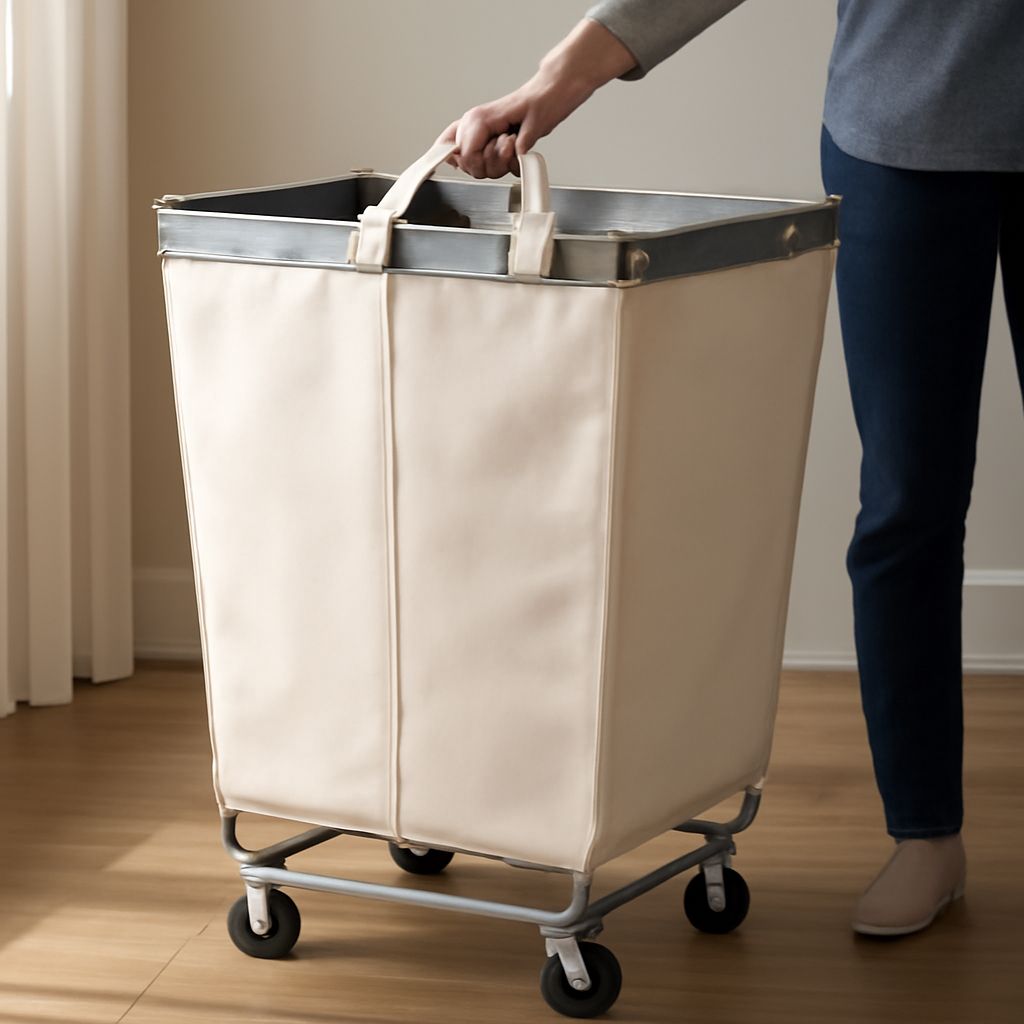
The right commercial laundry cart depends on load volume, travel distance, building clearances, and whether it carries clean or soiled linen. For most facilities, choose the smallest cart that holds one work cycle without overfilling. Commercial laundry carts commonly range from about 6 to 24 cubic feet, with smaller units serving room-level work and larger trucks supporting central collection.
Specify the format first, then check usable capacity, overall dimensions, casters, liner, cleaning method, unloading height, and storage. A cart that holds more but cannot turn through a doorway will slow the workflow.
Laundry carts by format: basket trucks, canvas hampers, shelf carts, bulk trucks, and tilt or spring-platform formats
Each format solves a different handling problem:
- Basket trucks: Rigid plastic or polymer baskets on a wheeled frame are versatile for housekeeping, guest laundry, and general linen transport. Sloped sides can allow nesting when empty. Rectangular baskets use floor space efficiently, while rounded corners reduce snagging in corridors and elevators.
- Canvas hampers: A fabric bag attached to a collapsible or fixed frame provides a lightweight option for collecting uniforms, towels, and room linen. Canvas hampers store compactly, but the liner needs regular washing and may not provide the leak resistance required for wet loads.
- Shelf carts: Open shelves suit folded clean linen, packaged supplies, and staged room deliveries. They provide quick visual access but do not contain loose or wet soiled linen well. Choose retaining lips or removable bins if the cart will cross uneven floors.
- Bulk trucks: Large, deep trucks handle high-volume collection in hotels, hospitals, laundries, and shared facilities. They reduce trips but require more clearance, stronger casters, and a planned parking location.
- Tilt or spring-platform formats: Tilt trucks rotate toward the operator for easier dumping. Spring-platform models raise the load as linen is removed, reducing repeated bending. These formats are valuable where staff load or unload carts throughout a shift.
For mixed work, use separate carts rather than one oversized unit. A shelf cart can move clean linen efficiently, while a covered or lined basket truck handles soiled material.
Capacity, dimensions, and handling: fit the load to the building
Size by usable capacity, not the outside measurement or maximum volume printed by the manufacturer. Leave roughly 15 to 25 percent of the interior free so staff can add linen, secure a cover, and move the cart without spilling. A 6-to-10-cubic-foot cart often suits housekeeping rounds or a small shared laundry. A 12-to-24-cubic-foot bulk truck is more appropriate for central collection, but only when the route supports its footprint and weight.
Estimate the load for one route or shift, then divide it among carts that staff can push safely. A single large truck may reduce trips, yet several smaller carts can improve segregation and reduce congestion. Check these measurements before ordering:
- Doorways and elevators: Measure the narrowest clear opening, not the nominal door width. Include the handle, lid, bumper, and caster width. Check elevator depth and door position as well as opening width.
- Turning space: Map corners, corridor junctions, loading areas, and housekeeping closets. A cart may fit straight through a doorway but fail to turn inside the room. Test the loaded cart on the tightest route.
- Weight: Combine the cart’s empty weight with a realistic wet-linen load. Wet textiles can weigh considerably more than the same volume of dry linen.
- Loading height: A deep truck may maximize capacity but force staff to reach into the bottom. Consider a lower basket, tilt body, or spring platform for frequent loading and unloading.
Use a push-first route wherever possible. Handles should provide a neutral grip, and the cart should remain stable when full. If staff must pull a heavy unit over thresholds, select larger casters or improve the route instead of relying on greater effort.
How to specify a commercial laundry cart: frame, liner, casters, and unloading
The frame determines durability and serviceability. Powder-coated steel suits demanding indoor use, while stainless steel is easier to sanitize and resists corrosion in damp laundry rooms. Polymer bodies are quiet, easy to clean, and resistant to many chemicals. Look for reinforced corners, replaceable bumpers, and a frame rated for the intended load.
Choose the liner according to the material being carried:
- Vinyl or coated fabric: Good for moisture resistance and frequent wiping. Sealed seams are important for wet or potentially leaking loads.
- Washable canvas: Breathable and relatively light, but it must be removed and laundered on a defined schedule.
- Removable bags: Useful for sorting and direct transfer to a washer. Confirm that the bag has secure attachment points and can withstand repeated lifting.
- Smooth polymer interiors: Best for fast cleaning and disinfection. Avoid deep seams or exposed fasteners that trap lint and residue.
Casters should match the floor and load. Four swivel casters provide easy maneuvering in tight rooms. Two swivel and two rigid casters track better over longer corridors. Five-inch casters work well on smooth indoor floors; six-inch or larger wheels handle thresholds, grout lines, and minor floor transitions more comfortably. Locking casters help with loading, but they do not replace a stable parking position.
For unloading, compare a fixed body with a tilt mechanism, bottom-dump design, or spring platform. Tilt features reduce reaching into deep trucks, while spring platforms keep the working surface nearer waist height. Confirm the dump angle, release location, and clearance needed behind the cart. The mechanism should not create a pinch point or require staff to stand in the cart’s travel path.
Commercial laundry basket selection for clean-versus-soiled separation
A commercial laundry basket works best for smaller loads, room-level sorting, and hand transfer between collection points. Select a rigid, vented basket for damp textiles, and choose reinforced handles that remain comfortable when the basket is full. Nesting baskets reduce storage volume, while stackable designs support organized staging when loaded.
Shape affects both handling and storage. Rectangular baskets fit shelving, carts, vehicle floors, and narrow closets with little wasted space. Oval or rounded baskets are easier to carry around corners and have fewer snag points. Tapered sides allow nesting, but excessive taper reduces the usable volume at the top. A broad, stable base is preferable when baskets will sit on a cart or floor.
Use color-coded baskets, printed labels, or separate cart bays for clean and soiled linen. Do not rely on memory or temporary signs. Healthcare and other high-control environments may need dedicated equipment that can be cleaned between uses, while hotels may prioritize nesting, quiet casters, and compact storage.
Industrial laundry hamper options for bulk handling and storage
An industrial laundry hamper is suited to high-volume collection, long routes, and locations where staff need a durable container rather than a hand basket. Select a rigid bulk body when loads are heavy, irregular, or likely to include damp textiles. Choose a collapsible frame and removable liner when empty storage space is limited.
For soiled linen, prioritize a washable or wipe-clean interior, secure closure, and clear segregation from clean-linen equipment. A lid or cover can contain odors and prevent material from falling out during transport. For clean linen, an open shelf or covered cart may provide faster access and reduce unnecessary handling.
Before finalizing the hamper, confirm its parked footprint, nesting or folding method, and access to the cleaning area. Storage capacity matters as much as transport capacity: several empty hampers should fit without blocking fire exits, service doors, elevators, or the next shift’s route.